In 1855 the curtain finally fell on one of London’s great public spectacles.
After seven centuries of riotous colour and raucous entertainment, Bartholomew Fair was closed by the City of London authorities.
Within a decade or so, the open ground at Smithfield, which, since the reign of Henry II had played host to mystery plays, jousts and executions was covered by the new buildings of Smithfield Market.
In his Memoirs of Bartholomew Fair (1859) Henry Morely laments the ‘…entire silence now on the historic ground over which, century after century, the hearts of our forefathers have throbbed with the outspoken joys of life, and with the suppressed agonies of death.’
He continues ‘…of the few popular Festivals that occasion yearly gatherings of strangers in the open streets of one of our great cities, this was the chief.’
Bartholomew Fair began life as a textile market huddled around the buildings of the old Priory.
Over the centuries it grew into a two-week festival where ‘the humour of the nation blended with the riot of the mob.’
There were numerous attempts to suppress it, including a concerted campaign in the 18th century to reduce its duration, but time and again, the energy of the Fair proved too strong for the authorities.
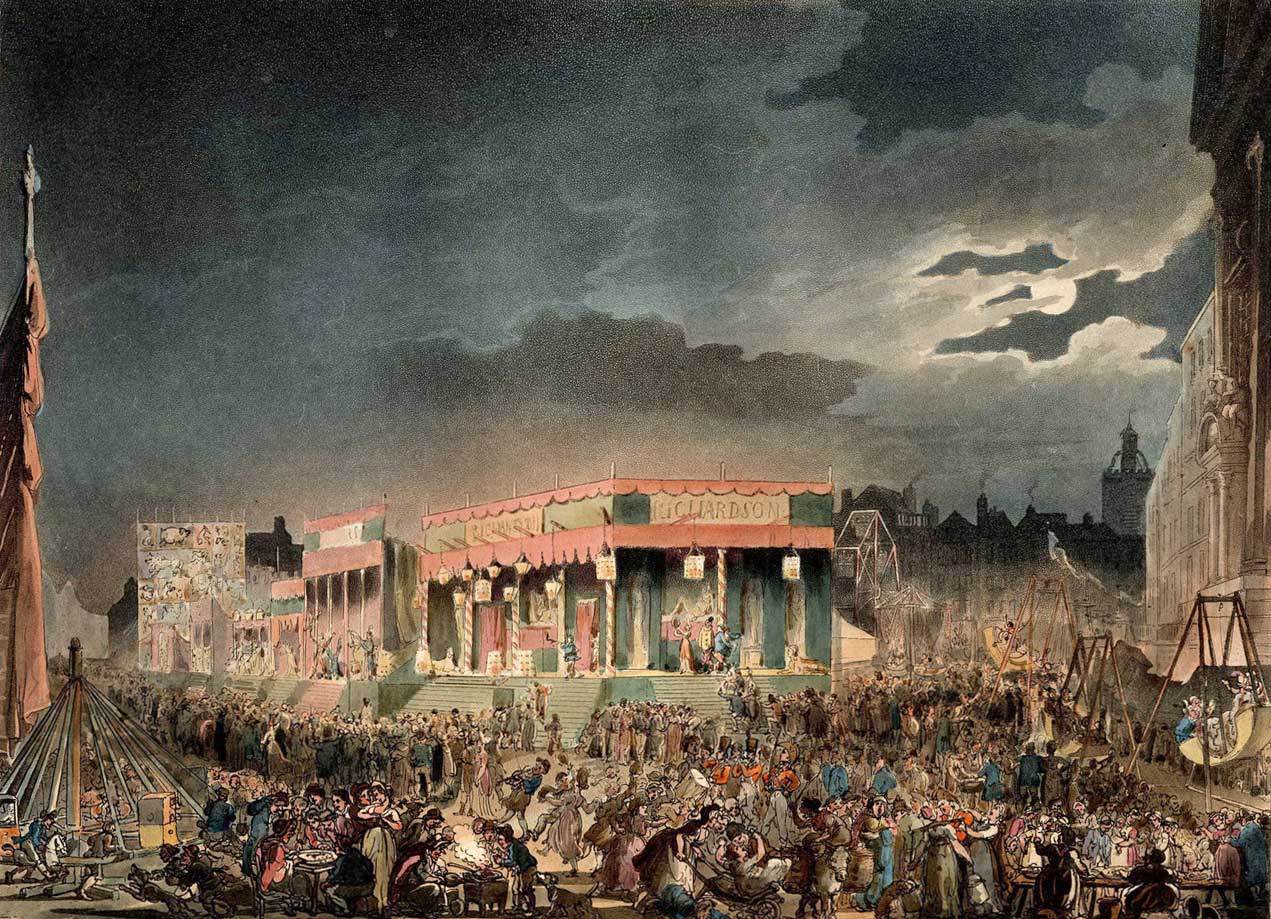
The spirit of Bartholomew Fair is captured in a beautiful aquatint in Rudolph Ackermann’s Microcosm of London published in the first decade of the 19th century. The Fair is shown in moonlight, with myriad figures enjoying fairground attractions, stalls, and dancing. The commentary lauds the print as a ‘spirited representation of the British Saturnalia’, guiding us to the sausage stall, the wild beast show, a Ferris wheel, and some swings where ‘a number
of youths… are carelessly disporting… Indeed so careless, that one of them appears to have
fallen out.’
Two centuries on from Ackermann’s magical illustration, Bartholomew Fair is making a comeback – supported by the very City authorities that supressed the festival in the 19th century.
From the 19th to 20th September lovers of spectacle and disorderly pursuits can enjoy the latest incarnation of the Fair – with performances, debates and cultural events across the Smithfield area.
Will Palin
A version of this article was
first published in the Covent Gardener Magazine