A short history of Barts North Wing
St Bartholomew’s Hospital is the oldest in Britain oldest hospital in the UK still operating on its original site. Founded in 1123, the hospital was re-founded by Henry VIII in 1547, surviving the reformation.
By the 1700s, the hospital’s buildings were outdated, worn, and too small to cope with the needs of London’s rising population. The leading architect James Gibbs was recruited to remodel the hospital. The North Wing was the first block to be completed, in 1734.
After 50 years without significant repair, the North Wing was in poor condition. A new charity, Barts Heritage, was established in 2017 to raise funds to carry out the restoration of the building. The Sharing Historic Barts project began in 2024 and completed in August 2025.
The Great Hall
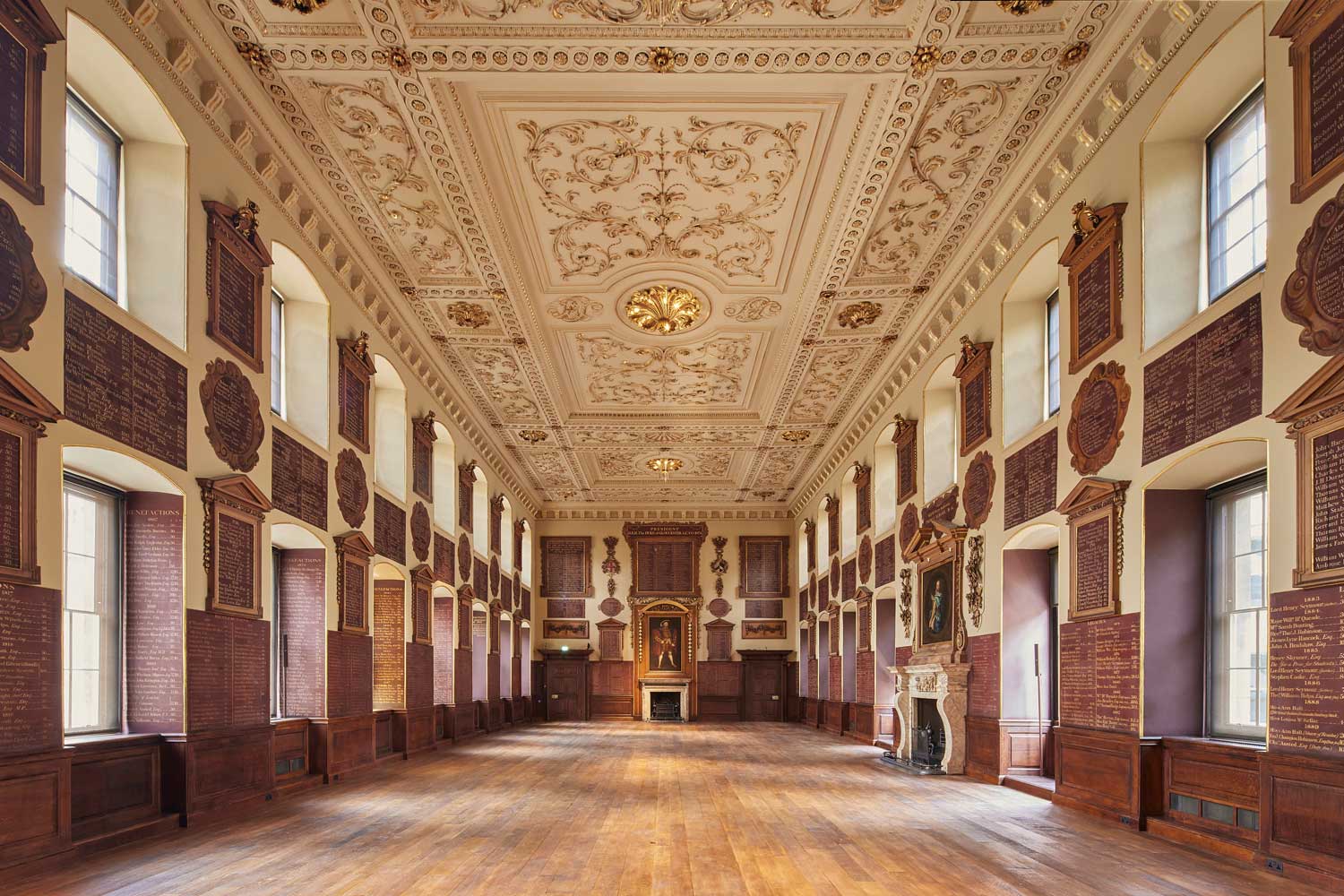
The Hogarth Stair brings visitors to The Great Hall on the first floor of the Grade I-listed North Wing. The North Wing was solely an administrative building, the hospital wards were housed in the other wings, as they are today.
Until the birth of the National Health Service (NHS) in 1948, the hospital was funded by donations. The names of benefactors (and the amount they gave) are recorded on the walls of the Great Hall.
Ceiling
The ceiling is the work of plasterer Jean Baptiste St Michele and represents his only identified work in the UK.
The design features scrolling acanthus, egg and dart, oak leaves (a symbol of strength), laurel wreaths (a symbol of triumph), bell flowers.
The applied moulded details of the cornice including the rosettes were created by the highly regarded plastering firm led by Chrystostom Wilkins and Thomas Currye, who worked on the ceiling of St. Mary-Le-Strand.
Artworks
Portraits
Three large portraits hang in the Great Hall, King Henry VIII, The Prince of Wales (later King Edward VII) and Saint Bartholomew.
King Henry VIII
The painter is unknown, but the painting is in the style of Hans Holbein the younger. The original hanging of the portrait was supervised by James Gibbs and William Hogarth in 1738.
Image courtesy of Barts Health NHS Trust Archives
King Edward VII
The Prince of Wales (later Edward VII) made the first ever official royal visit to the hospital in January 1868. The year before, he had become the hospital’s first Royal President. This 1901 portrait is by Luke Fildes.
Image courtesy of Barts Health NHS Trust Archives
Saint Bartholomew
The hospital’s patron saint, Saint Bartholomew, is represented here. The painter is unknown. Bartholomew was one of Christ’s Twelve Apostles. In this painting he holds a flaying knife, the instrument of his martyrdom.
The hospital was dedicated to St Bartholomew by its founder Rahere.
Image courtesy of Barts Health NHS Trust Archives
Charter Window
The Charter Window
At the centre of the South wall of the Great Hall is the stained glass of The Charter Window. It was installed in the Great Hall in 1743, and shows King Henry VIII handing the charter declaring the re-founding of the hospital.
The window pre-dates the Great Hall, and its earliest elements are from the early 17th century.
Repair and conservation
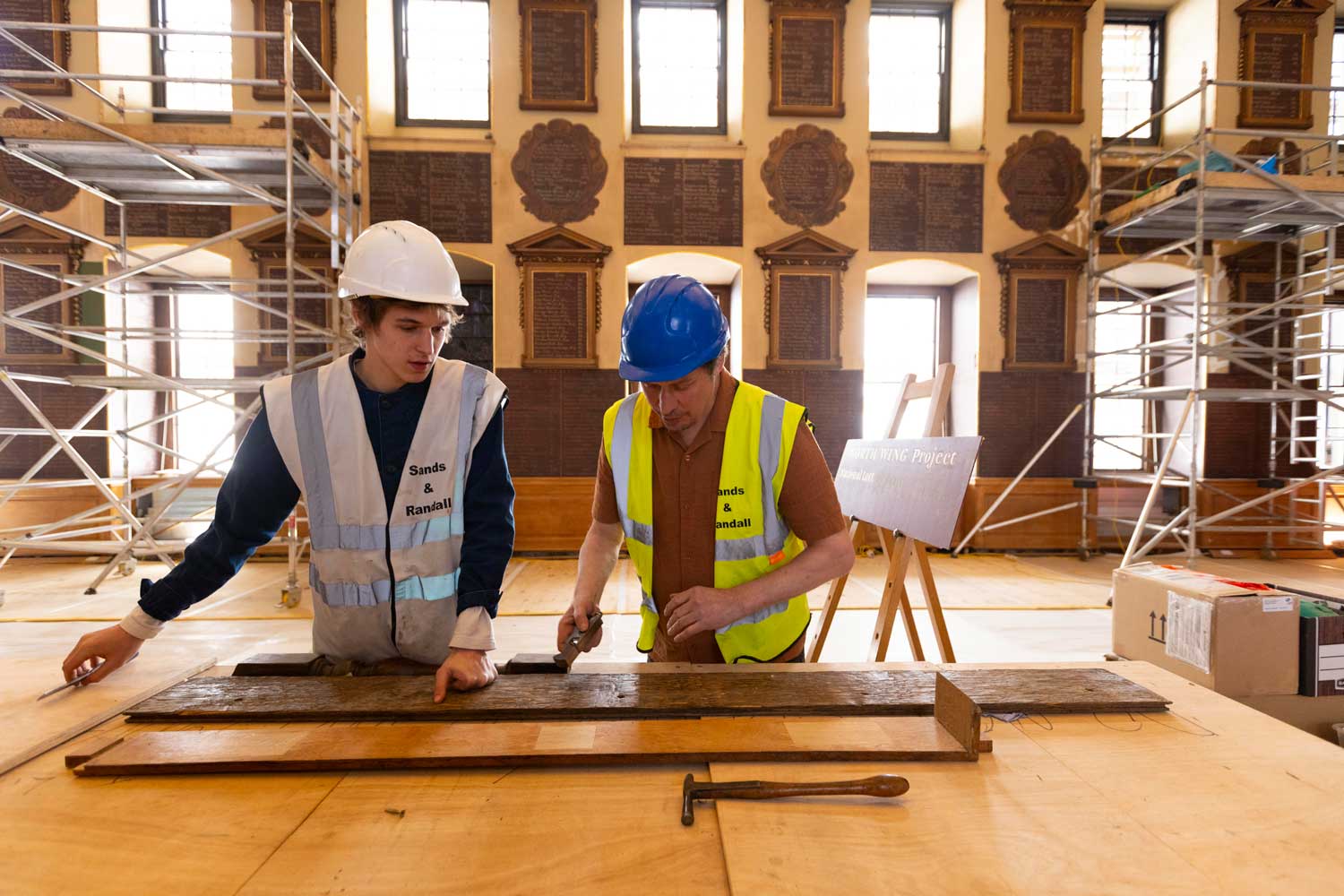
Extensive work was carried out throughout the Great Hall. The ornate plasterwork of the ceiling has been repaired and redecorated, with work carried out from a deck supported on a ‘birdcage’ scaffold suspended above the floor via struts through the windows connected to the external scaffolding. While the deck was in place our engagement team ran a programme of public scaffolding tours allowing visitors to watch the conservators at work.
The sash windows and the oak flooring were removed for repair and renovation, and miles of new cabling and pipework was installed under the floor before it was replaced and refinished.
The Charter Window depicting the re-founding of the hospital being granted by Henry VIII was removed, restored, conserved by the expert team at Holy Well Glass and re-installed in April 2025. The panelling and the doors were gently re-coloured and polished, and wall surfaces were repaired and redecorated .
A timeline – 900 years of building at Barts
Use the arrows to navigate through the timeline.
Hover or click to pause.
The Hogarth Stair
The staircase
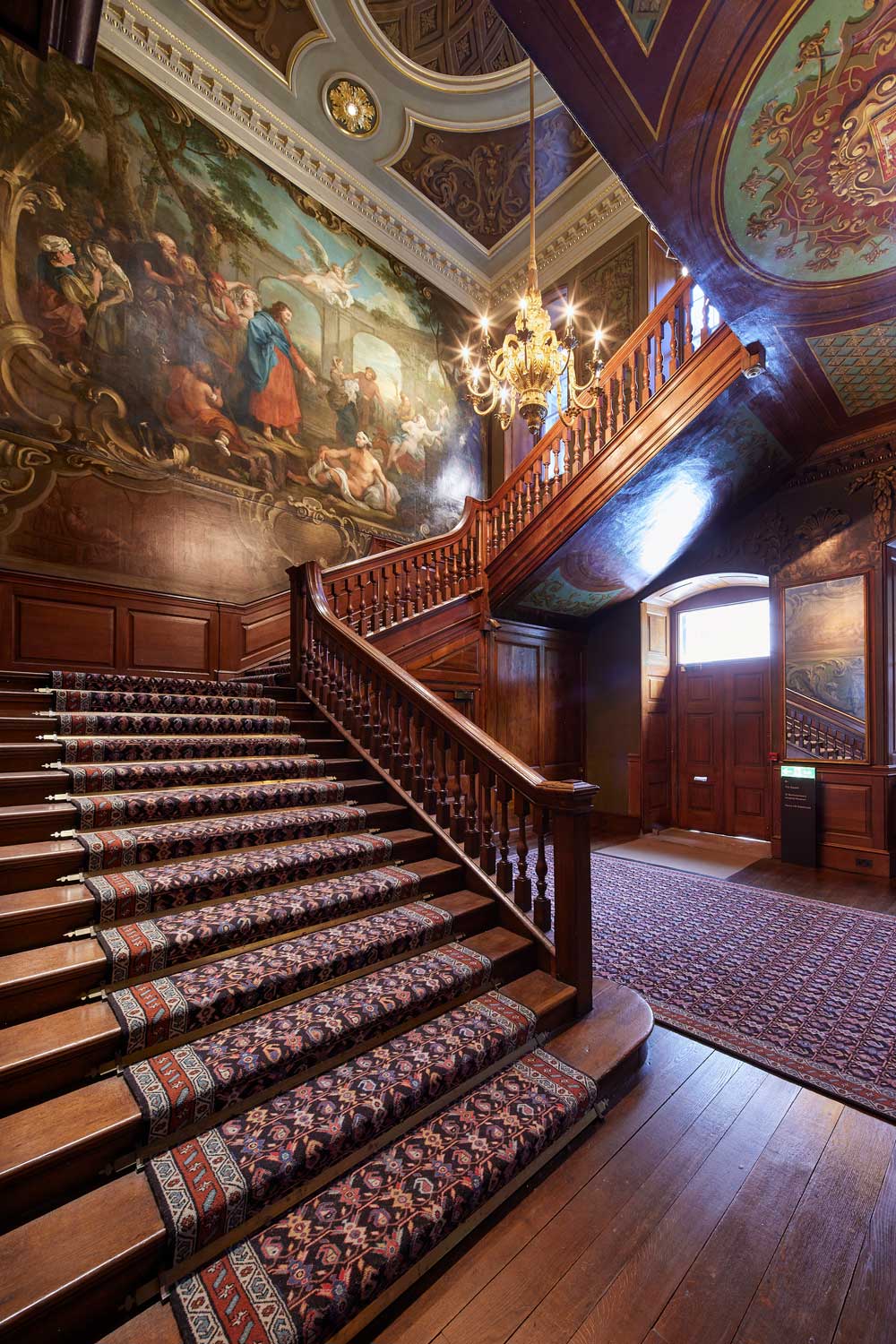
The entrance to Barts North Wing opens into the grand, highly decorated staircase hall known as the Hogarth Stair after the named the artist whose paintings dominate the space.
The walls of the Hogarth Stair feature two huge canvases by William Hogarth – best known at the time for his popular engravings, but also an accomplished painter.
The Good Samaritan and The Pool of Bethesda were Hogarth’s first large-scale history paintings – depicting stories from the bible at huge scale, with figures put to seven feet high.
Hogarth decorated the stair free of charge, allowing him to indulge his ambition, and giving the hospital a grand entrance to the Great Hall at no cost.
Photograph by Matthew Andrews
The Good Samaritan
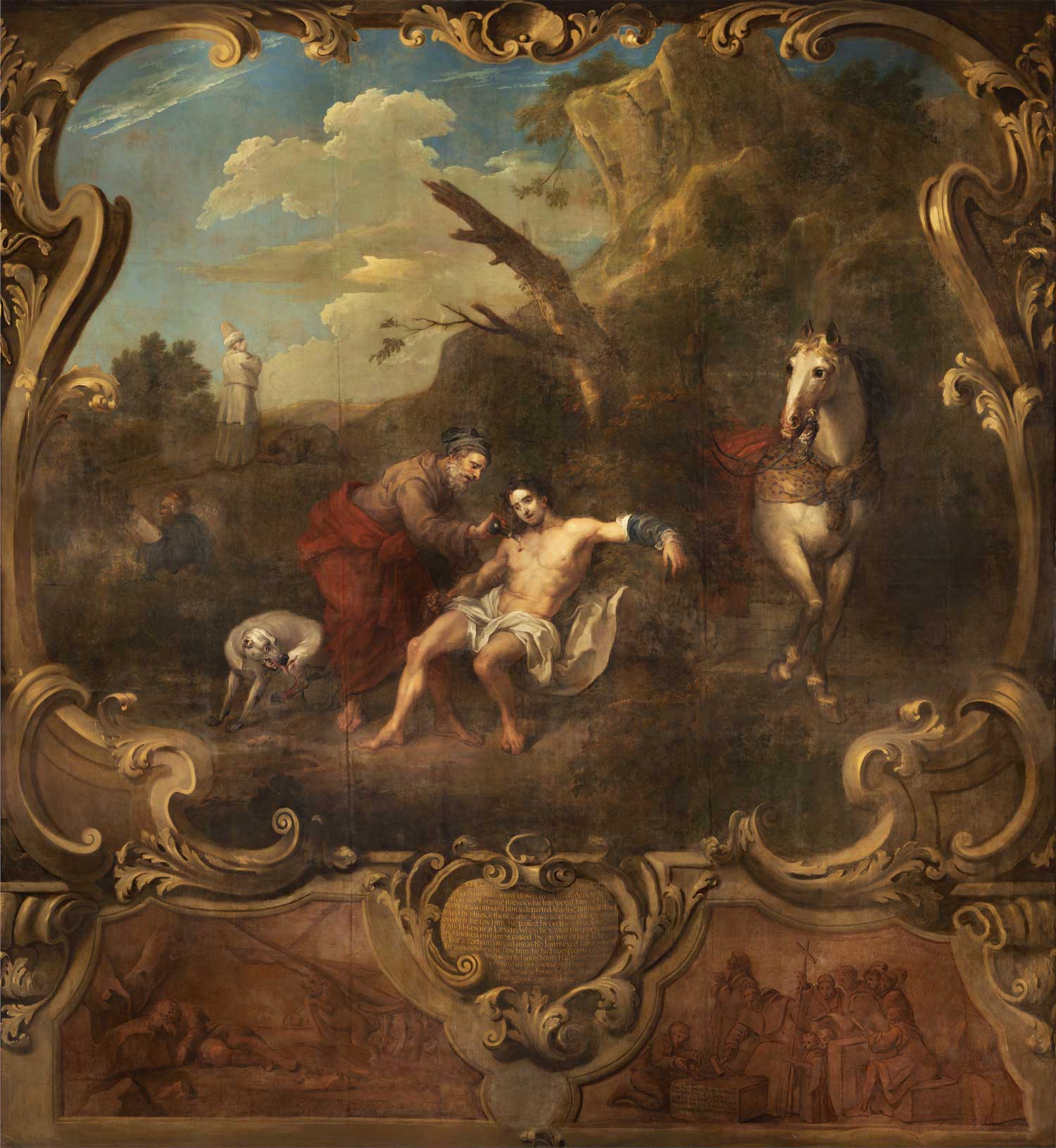
The Good Samaritan depicts the biblical story showing the Samaritan pouring oil and wine into the wound of the injured man.
Beneath the paintings are three cartouches by Hogarth’s assistant Mr Richards and show the life of Rahere. It the first he is shown experiencing his vision, in the second the foundation stone of the hospital is being laid and in the third, a sick man is being carried on a stretcher into the hospital.
The walls on the landing are decorated with paintings of Galen and Hippocrates and baskets of flowers.
The Good Samaritan was painted on site. It was completed in 1737.
The Pool of Bethesda

This painting shows a scene from The Gospel according to St John, in which a lame man who has been unable to walk for many years is healed by Jesus. Jerusalem’s Pool of Bethesda was thought to have healing properties.
The Pool of Bethesda was painting off site and installed in 1736.
Conservation, Repair, and Restoration
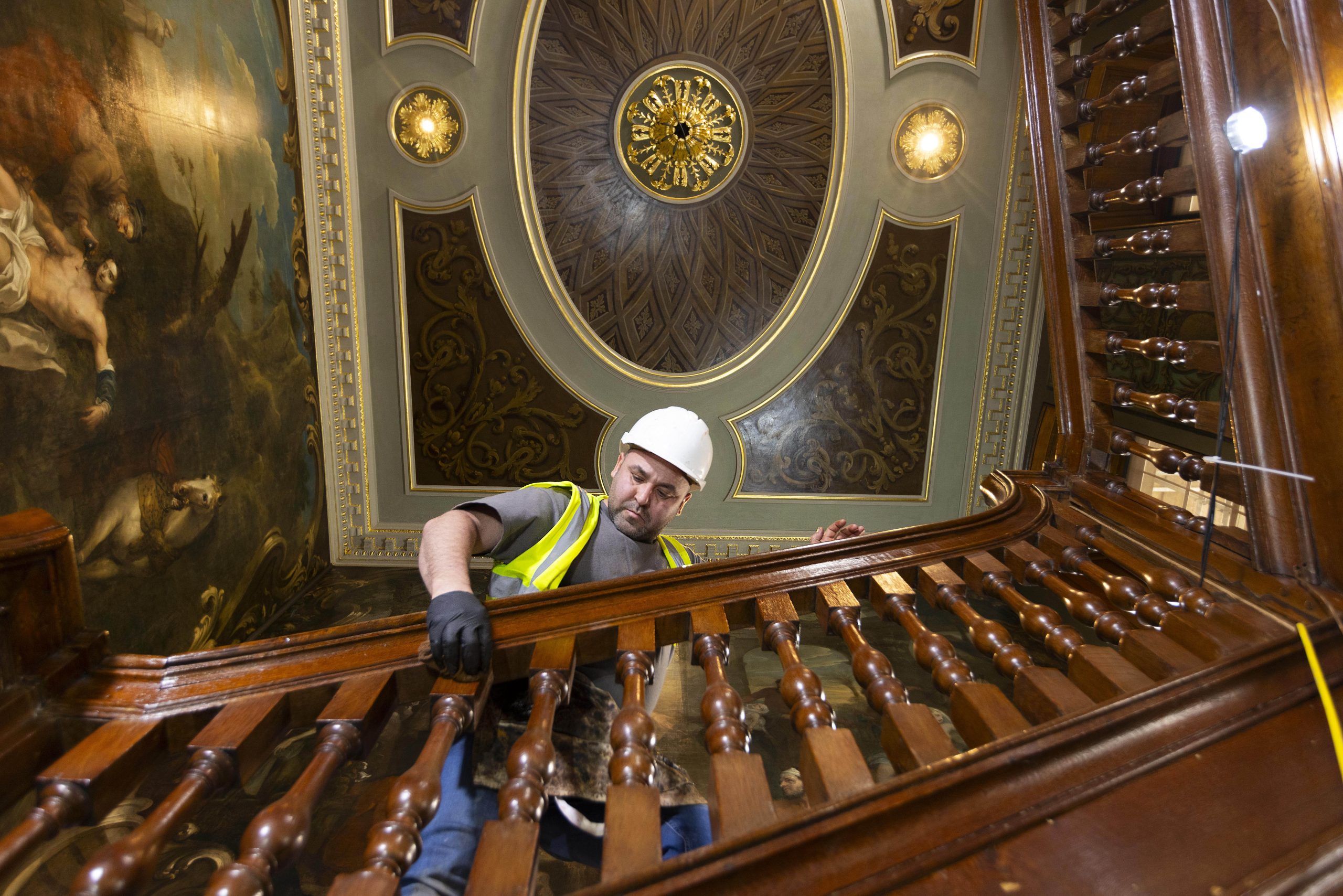
The Hogarth Stair’s ornate decoration has been expertly restored and cleaned, and repairs have been made to the woodwork of the staircase itself and the panelling on the walls.
Conservation specialists Stephen Paine and Sophie Stewart led a team including students studying conservation who carefully cleaned and conserved William Hogarth’s monumental staircase paintings.
New energy-efficient lighting has been installed, designed to help present the Hogarth paintings at their best. French polishers have re-finished the woodwork with a subtle darkening.