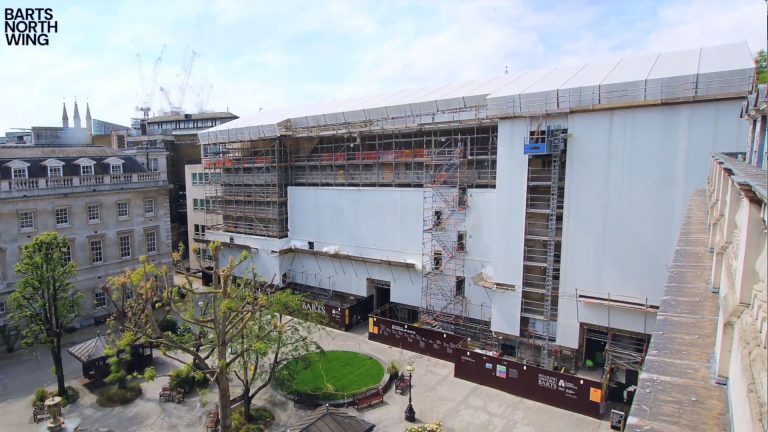
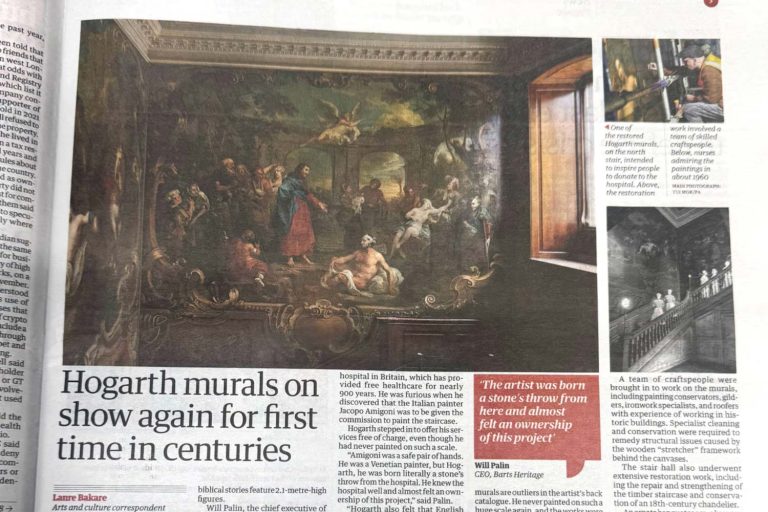
The North Wing at St Bartholomew’s Hospital is one of the most spectacular hospital buildings anywhere. With the repair, restoration and conservation phase of the Sharing Historic Barts project approaching its conclusion, we can now start to see how the meticulously refreshed interior and renewed exterior will serve as a creative and inspiring cultural space.
I am privileged to be part of a diverse and passionate group of practitioners working from health to heritage who have been advising the project team for the last twelve months. Our role is to help maximise the benefits of the project, develop new connections, and explore how these remarkable spaces can best enhance the wellbeing of visitors: staff, patients and their families, and local communities.
As a group, we have been lucky to hear and reflect on the positive responses to participatory sessions focused on wellbeing, get our hands on a beautifully crafted creative patient activity pack, and see the incredible ceiling of the Great Hall up close in the midst of its makeover.
During our meetings, we have been surrounded by boards recording the gifts of many donors who contributed to the work of Barts. These remind us that access to healthcare – and heritage spaces – was for a long time only possible for some; hospitals were largely places for those who could not afford the services of a private physician.
As a historian of modern medicine, it has been heartening to hear how the project activities are creating a strong sense of emotional connection for visitors. My next involvement with the project will be developing and running training for the new volunteer Visitor Experience Hosts. This presents a fantastic opportunity to share some of the key moments and changes in the history of medicine that are fundamental to my research, but also to talk openly and responsibly about the differences between how health, illness and disability were viewed in the past and how they are experienced today.
Projects such as Sharing Historic Barts need people with complementary skills: audience engagement, evaluation, conservation, and many more. But they also need the buy-in of groups they are hoping to reach. I have learned a huge amount about the priorities of different groups of staff at Barts, and how challenging it can be to promote the value heritage in a healthcare setting that is stretched to capacity. Bit by bit, though, we are seeing that when people have the chance to make space for creative or participatory activities focused on wellbeing, they feel real, tangible benefits. For me, working with like-minded members of the advisory group, and the project team, to open those opportunities to wider audiences is a source of wellbeing in itself.
James Stark
Director, Centre for History & Philosophy of Science
Professor of Medical Humanities, University of Leeds